

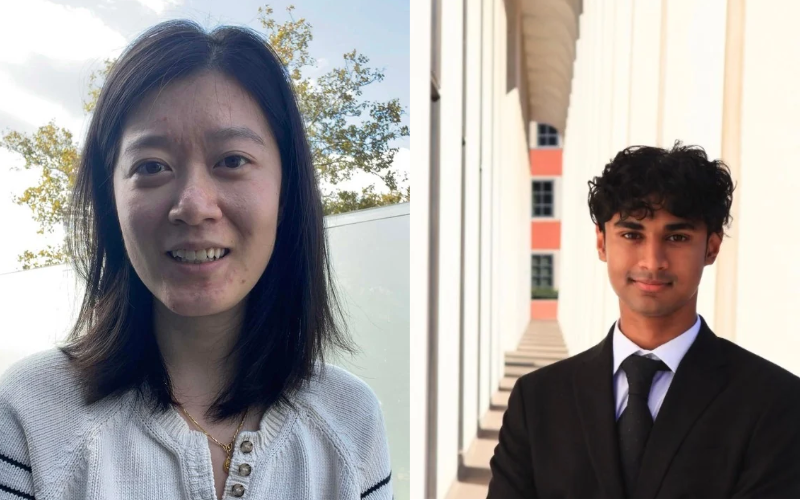
Pictured: Madelyne Xiao (left), Jason Persaud ’27 (right)
Jason Persaud: I’ll start with a basic intro: could you tell us a little bit about your work and the research you do?
Madelyne Xiao: I’m broadly interested in online speech and identity, but also the media and how news is made. That includes what happens in the newsroom, on-the-ground reporting, and the security of sources during investigative, primary-source reporting.
I use a mix of techniques, including user and measurement studies. More recently, I’ve been working with my collaborator at CMU, Sarah Scheffler, using applied cryptography to develop pipelines for private analytics on encrypted messaging. Depending on the day, I might be doing human-factors research or more “applied-crypto-flavored” things. It’s all with an eye toward understanding how people represent themselves online, and how offline values—like polarity and authenticity—translate to digital identity.
Jason: That’s really cool. Your path to where you are now involved a lot of journalism, fact-checking, and science writing, but now you’re in computer science research. What inspired you to study the information ecosystem from a technical perspective?
Madelyne: The fact-checking role was probably the most instrumental. I worked in The New Yorker’s fact-checking department, which is a very particular place to work. I don’t think anything quite like it exists in any other media outlet.
Working on a daily website and a weekly magazine, we were trying to do labor-intensive checking at scale with a relatively small crew.
As a first-year grad student working with my adviser, Jonathan Mayer, I investigated automated fact-checking systems. I was immediately struck by the disconnect between what I understood fact-checking to be and what academic ML and computational linguistics researchers thought it was: there was a level of reductionism required in the academic interpretation to make the problem small enough for a machine learning classifier to handle.
So much of manual fact-checking is context-building, relationship management, and on-the-fly research. In the academic ML literature, by contrast, fact-checking is more commonly formulated as an information retrieval problem. Coming from a journalism background, where I did this work manually for a long time, I felt that this wasn’t a representative formulation of such a gnarly problem. It’s not just an information problem; it implicates reader bias, the outlet’s reputation, and so much more. These conceptions of “fact-checking”were worlds apart.
Soon after I concluded the fact-checking work, I realized that many problems applied cryptographers work on—like encrypted messaging and source security—would be fascinating to journalists. These two groups don’t talk much. Tools developed by cryptographers are often cool in theory but nearly impossible for a busy journalist to use. Most journalists are more worried about their next gig or keeping up with the news cycle. They want an easy, out-of-the-box tool. Designing for an audience that needs these tools but has limited bandwidth to understand the “how” behind them is a very interesting problem space.
Jason: You mentioned applied cryptography. Is that a project you’re currently working on?
Madelyne: That’s been on the back burner a bit because some age-verification work has taken priority, but I’ve worked on it with Sarah for the past two years — we’ve been designing and testing a tool for performing private analytics on encrypted WhatsApp messages (we’ve been describing it as Google Trends for encrypted texts).
Jason: Would you like to talk about a project you’re currently focused on?
Madelyne: Sure, I can give you two. First, with Jonathan and Manoel, I’ve been auditing the Community Notes platform on Twitter (or X). We’ve been at it for over two years, which makes it a bit of a dinosaur in computer science terms. We spent over a year just collecting the cumulative data dumps the platform releases every 24 hours.
We wanted to understand the platform on its own terms—running the algorithm to see how polarity scores correlate with the notes actually published. Now, we’re in a phase where we’re asking Community Notes users about their political preferences to see how those offline notions interact with their activity on the platform.
The second project is the age verification work. There’s a lot of talk in the U.S., U.K., E.U., and Australia about “age gates.” We’re specifically interested in biometric approaches to age verification. To verify if someone is under 18, you essentially have to check that everyone else is over 18, meaning millions of people are exposed to these systems. There is very little independent evidence on how well they work in non-ideal use cases, including in many real-world scenarios (e.g., in poor lighting). Most testing is done by the companies themselves, so we designed and completed our own privacy-preserving evaluations with in-person participants.
Jason: Both of those are fascinating. I use Twitter all the time, so I see Community Notes constantly. I’ve also seen the discourse around age verification on platforms like Roblox.
Since your work is so interdisciplinary, combining journalism with complex computational methods, what advice would you give to undergraduates looking to enter this field?
Madelyne: That’s a great question. My advice isn’t necessarily academic. I owe a lot of my current research direction to the fact that I took a few years off between undergrad and grad school to work full-time. I left undergrad with a bucket of interests but no real depth of understanding. I felt that I needed to spend time in the world to figure out which specific things I wanted to spend five or six years of my life digging into.
I did a post-baccalaureate at a natural history museum, then did a lot of media work. Through that, I realized I liked research, teaching, and working with journalists. Even during the “craziest” writer-editor interactions, I loved the behind-the-scenes work in newsrooms that readers and researchers often don’t see.
So, my advice is to take time off, if you’re considering graduate school but not sure about your next move. If you like media, spend time in a newsroom. See if technical research is something you want to combine with your other interests. You might decide that a PhD is right for you (and, if so, you’ll have a better sense of the problems you’re interested in working on). Or you might find that you’re happy pursuing a career outside of the academy – better to know this sooner rather than later.
Jason: Last question: what is the most interesting tidbit or surprise you’ve taken away from your research or experience?
Madelyne: On the research side, when we looked at automated fact-checking, we found a total lack of agreement on the definition of “misinformation.” A common workaround is “detection by proxy.” Instead of checking facts, a system might detect strong emotion or virality and use those as markers for whether something is true. As it turns out, that only works sometimes!
Jason Persaud is a Princeton University junior majoring in Operations Research & Financial Engineering (ORFE), pursuing minors in Finance and Machine Learning & Statistics. He works at the Center for Information Technology Policy as a Student Associate. Jason helped launch the Meet the Researcher series at CITP in the spring of 2025.
Leave a Reply