Author: Sophie Cipolla
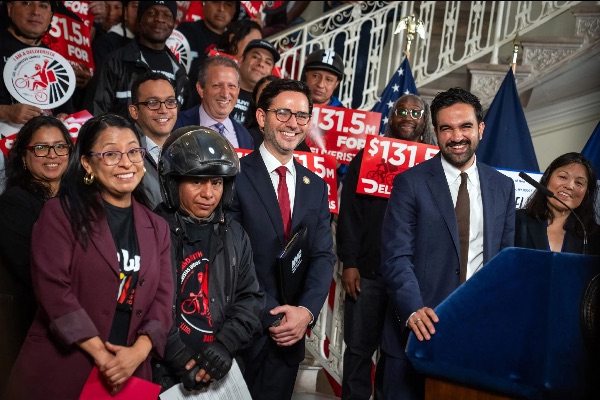
Image courtesy of NYC Office of the Mayor.
A seismic shift in the workers’ rights landscape occurred recently, and two of CITP’s researchers were at the scene of the victory. A historic $131.5 million settlement with DoorDash – the largest in New York state history – was announced in September. The Workers Algorithm Observatory (WAO), heralded by Samantha Dalal and Andrés Monroy-Hernández, will be providing the development of infrastructure for ongoing compliance monitoring of the platform.
Dalal and Monroy-Hernández are both award-winning technologists and technology researchers who have successfully bridged the gap between problems and policy. What sets apart their approach, however, is that they’re solution-first, not tech-first. “We don’t really care how sophisticated the technological solution is,” Monroy-Hernández says. “We care more about the specific problems people have and how to address them.”
The Workers’ Algorithm Observatory, or WAO, builds tools to investigate black-box algorithmic systems, to shift the power back to the workers who use them and ultimately hold these systems to account. Dalal and Monroy-Hernández, along with CITP Fellow ‘23-24 Prof. Dana Calacci (now a professor at Penn State), launched the organization in 2022 to develop support for workers and better understand the nebulous factors that determine pay, schedule, and more for millions in the U.S. platform economy.
The collaboration Dalal and Monroy-Hernández forged with the New York City Department of Consumer and Worker Protection comes at the end of a winding and circuitous road, including years of invisible labor and organizing outside the halls of Princeton. In fact, the impetus of the partnership was one of the connections in Monroy-Hernández’s network.
“I had a contact who was already working on the DoorDash case, looking for people who could help make the case stronger,” he shared. “I connected with them and was a consultant for the case for months. Then through that established relationship, when they were looking for someone on their team to facilitate connections with workers, I linked them with Samantha.”
Says Dalal, “This is the culmination of months of work between different parts of our lab, and these serendipitous connections with people who are interested in connecting with academics, and open to this collaboration, which is not as common as you would expect.”
This kind of coalition-building requires a significant commitment of time and labor for an unknown payoff, and it’s labor that often falls outside the scope of academia, but shouldn’t – especially if academics are aiming to do impact-focused work. The infrastructure and support that CITP provides, in terms of diversifying the types of academic output classified as ‘impactful,’ goes a long way toward furthering projects and partnerships like this one. “We have amazing researchers that get the institutional support and funding from CITP to go out in the field and do these long-term community engagements,” Dalal said.
The model that CITP has for framing impact, and defining the timelines that support the many shapes that impact can take, is all the more remarkable because in some ways, it operates counter to a traditional academia mindset or reward structure.
“Part of what we’ve learned from this is that often the academic approach is to spend years on your own building a tool, and then go about shopping for users. That tends to fail, and it’s not really the right model, especially for this kind of work. The right model is working on tool-building with the partners,” Monroy-Hernández said. “The shorter amount of time between ideation and collaboration with the organization, the better.”
Ultimately, this means driving research and product development by the needs of the organization, not just the interests of the academic creating the tool, which has been another cornerstone of WAO and CITP’s approach.
An example of this ethos in action is Handlebar, a system that Prof. Calacci at the WAO developed in tandem with a group of researchers from the City University of New York conducting research on the wellbeing of food delivery workers in New York City. The application was developed to allow for the capturing of phantom data that slips through the cracks of platform APIs entirely. For example, there are certain incidents or disruptions workers might experience that occur only on their device – like if a worker doesn’t accept an offer to drop off a pizza at a specific location.
“A lot of API data is only of events that actually happen, but the existence of an offer like that does not get represented in the data,” Dalal explained. Thus precipitated the creation of Handlebar, which allows for the capturing of these ephemeral, fleeting worker-device interactions that otherwise don’t get recorded for posterity.
Following the settlement collaboration, WAO is exploring how to use the technology underpinning Handlebar to capture the data needed for this ‘groundtruthing,’ using the tooling and connections they’ve built with the delivery worker community.
“As part of the settlement, DCWP will get data from DoorDash that details how much DoorDash says they pay drivers, how long drivers worked, when drivers were paid, et cetera,” Dalal explained. “But because there’s been so much trust broken between the workers and their enforcement agencies and the company, they don’t fully trust the data that DoorDash is giving them. That’s why they made this contract with us, because they want us to build them tooling and capacity within these driver organizations to help them provide the ‘ground truth,’ or workers’ version of what they see on the app directly, to the enforcement agency – so they can validate the information they’re receiving from the apps.”
This solution-first approach is informing WAO’s collaboration with the Workers Justice Project, and helping them to understand workers’ existing workflows on their phones and the types of tools they’re open to using. “You would not even believe how innovative the phone setups workers have are,” Dalal said. “Building a product that’s going to work to collect all this data won’t necessarily be easy.”
Another WAO-government collaboration in the pipeline is with the Seattle Department of Transportation, to help model the impact that the introduction of self-driving car taxis will have on traffic in the city. “Many of our collaborations have grown out of existing connections, or are different uses of similar technologies that add new capabilities to the services that we were building with,” Monroy-Hernández said. “I think that model has given us the ability to branch out while being grounded in these connections.”
He cites the Coalition for Independent Technology Research as important thought partners in Handlebar’s development, and as fellow advocates for these tools. “There’s a network of great researchers who are trying to create this open ecosystem for doing platform research,” he said, all aimed at bridging the gap between what is technically possible with what is socially feasible.
Dalal and Monroy-Hernández both bring years of experience as outstanding community-builders dedicated to understanding the broader social context of their work.
In fact, while Dalal was completing her PhD at the University of Colorado Boulder, she started working in Colorado with the Colorado Independent Drivers United, a local chapter under the CWA Communication Workers of America National, to collect data on these questions. “It took a lot of time to build that trust,” Dalal shared. “They essentially invited me to be part of their union as an organizer, and I worked with them very extensively for two to three years.”
Forging that relationship involved performing many tasks that weren’t necessarily tied to Dalal’s research, including helping CWA with organizing efforts and being on hand to testify for bills the union was aiming to get passed. The sincerity and depth of her commitment was apparent, and laid the groundwork for her later collaborations with workers’ unions.
Monroy-Hernández, meanwhile, developed a tool called Scratch while in graduate school at the MIT Media Lab – aimed at a younger audience than WAO’s applications, but with a similar goal of empowering the user. “It’s a tool for kids to learn digital literacy by being creators of their own animations, video games, and interactive art,” he explained. “In the process they engage with data, because if you want to create your game, you need to collect data.”
“Scratch is how I learned to code!” Dalal chimed in. “Andres has been doing impact-focused work his entire career.”
“I think kids who grew up engaged in those kinds of programs, where they learn to be creators themselves, have that much more awareness of these issues and will probably be better informed citizens when it comes down to voting in appeals for their state, and so on,” Monroy-Hernández said.
While this kind of engaged public scholarship is often associated with the realm of the humanities or social sciences, Dalal and Monroy-Hernández are shining examples of technical scholars doing important work for the public good, bridging the intellectual resources of big tech and academia with pressing social problems that need to be solved.
One of CITP’s missions is to shape a populace that is digitally literate, with the tools and frameworks in place for people to advocate for themselves and be stewards of their own data, while also creating and furthering the big-picture infrastructure at the government levels to ultimately support democracy and citizens’ rights. Dalal and Monroy-Hernandez’s work exemplifies that when technology is built alongside communities rather than for them, it becomes an even more powerful tool for transparency, accountability, and furthering democracy.
Leave a Reply