

Authors: Mihir Kshirsagar (Princeton University)
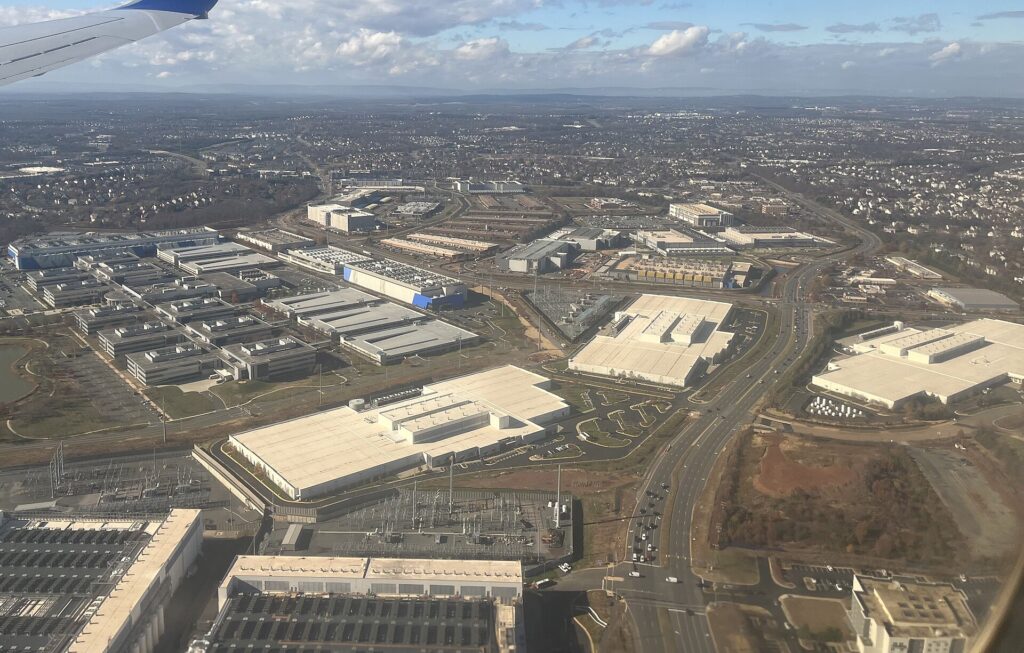
Data centers in Ashburn, VA. Image courtesy Wikimedia Commons.
Arvind Narayanan kicked off CITP’s seminar series for the academic year by arguing that we should invest in augmentation rather than automation for AI development. I find that call inspiring. But with the enormous amounts of money that are flowing into data centers, I wonder how this agenda squares with the need of the industry to pay back the vast sums they are borrowing to fuel the current AI infrastructure boom. Later this week, I am presenting a paper that Felix Chen and I wrote about the competition implications of the current AI buildout at TPRC 54. Here, I look at the capital expenditures to understand how the industry is positioned for that future, and what it means for the viability of the business model. The Anthropic Institute’s recent economic report that analyzes potential pathways to AI’s contribution to the economy is a helpful guide to the inquiry. Also, David Rotman has a fascinating deep dive in MIT’s Technology Review on the sustainability of current investments.
There are several ways to tackle the question of the sustainability of the investment model. One way, at a high level, is to ask how future revenue flows will pay for the stacked vintages or fleets of computing equipment that the companies are buying each year. For reference, Goldman Sachs estimates that the “compute equipment inside AI data centers costs 3-4x more than the physical data center itself.” These servers have to generate sufficient revenue to pay their costs within their useful lives. The hyperscalers peg their useful life at 5 to 6 years. I’ve written previously that the assumption is questionable, but we can put it aside for now. We can set up a simple model to help us understand the different revenue sources that can generate the cash flows to support the expense. There are two potential options:
- GDP Growth: AI boosts productivity and then captures a share of the GDP growth those enhancements bring.
- Wage Capture: AI automates tasks and shifts what people are paid for their labor to payments to AI firms.
Notably, in the past the buildout was funded by cash flows from the hyperscalers’ existing businesses. As companies turn to debt to fund the data centers the revenue question looms large. In the United States we spend roughly $16 trillion a year on labor. The critical question is how much cash flow can AI-led GDP growth generate without taking share away from what we spend on labor, which is after all the goal of the augmentation agenda.
The Anthropic Institute’s analysis posits three different scenarios for AI contribution to growing the economy: modest, substantial, and extreme. Under the modest assumptions, which is slightly above what the economist Daron Acemoglu estimates, AI net contribution in 2030 is a 1.6% addition to the U.S. GDP. That amounts to about $540 billion in 2030. In the substantial scenario, the contribution is 8.3%, or $2.8 trillion. In the extreme scenario, it is 32.4%, or $10.9 trillion.
Table 1. Anthropic’s three scenarios in 2030 (2025 dollars)
| Without AI | Modest | Substantial | Extreme | |
| GDP Boost | — | 1.6% | 8.3% | 32.4% |
| 2030 GDP | $33.6T | $34.1T | $36.3T | $44.4T |
| Annual gain | — | $540B | $2.8T | $10.9T |
| — change in capital income | — | $416B | $2.54T | $10.92T |
| — change in labor income | — | $121B | $282B | $101B |
| Labor share of income | 60.0% | 59.4% | 56.1% | 45.2% |
Put differently, we can estimate the cash flow required for data center debt repayment as a question about what would be the “take rate” this capital layer captures of the benefits it delivers to the economy as a whole. We can do some back-of-the-envelope projections to rough out the revenue assumptions that will match the spend. If the gains to the economy are less than the amount for the AI companies’ spend, there will be a deficit. That would either be realized through investment losses, or the AI firms make that revenue by capturing a share of wages.
Now let’s examine the spending side. Goldman Sachs Research estimates that the U.S. spending on data center infrastructure will amount to $581 billion in 2026. They estimate that about 67% of that is on the compute cost. And the amount spent on data centers in the United States is projected conservatively to grow by 16% annually. The notable aspect of this spend, PwC explains memorably, is that a data center is a “chip-replacement subscription with a building wrapped around it. Build the box once, refill it every four to six years.”
Table 2. U.S. AI infrastructure investment (estimates)
| Year | Investment |
| 2025 | $304B |
| 2026 | $581B |
| 2027 | $674B |
| 2028 | $782B |
| 2029 | $907B |
| 2030 | $1,052B |
So now we have the elements in place to run the revenue calculation: what would it take to simply return the money spent on the equipment? By 2030, that amount will be $480 billion under some very generous assumptions. It will then rise to match the ongoing spend. Note, this figure is the annual cash flow required in 2030 simply to pay back the principal on the server fleet—dividing the cumulative $2.88 trillion spent on compute between 2025 and 2030 evenly across a six-year useful life, with zero return on capital and zero operating costs.
Table 3. Required revenue for servers as a share of the gain
| Modest | Substantial | Extreme | |
| $480B (owed in 2030) | |||
| of the whole GDP gain | 89% | 17% | 4% |
| of the capital gain share | 115% | 19% | 4% |
The crucial question then is the take rate of the servers: how much of what AI adds to the economy flows back to the capital spent on servers. Ordinarily, the entire capital layer gets about 40% of the income. In the three different AI growth scenarios, the Anthropic Institute report estimates that capital owners capture a large share of the surplus: about 75% in the modest scenario, 90% in the substantial one, and an even larger share in the extreme. But the servers still have to compete for a slice of that gain. As shown in Table 3, the projections signal there are major sustainability challenges ahead. In the modest scenario, the cost of servers swallows everything capital earns on the new output. In the substantial scenario it is technically possible, but depends on capital owners capturing a fifth of the capital gain solely to repay the fleet cost.
Which brings us back to augmentation versus automation. The only other way for the AI firms to fund their spending is to capture through automation the income that would otherwise go to labor. If we examine the current spending rate, it looks like the AI firms are betting on the substantial path outlined by the Anthropic Institute. In other words, the demands of the current AI spend anticipate and require transfer from labor to capital. The Anthropic Institute’s own substantial scenario observes that labor’s share of GDP falls from 60 to 56 percent, even as labor income grows. But, as Sayash Kapoor and Arvind Narayanan have argued persuasively, the assumption that AI firms can capture a significant share of wages is built on shaky foundations. To date, we see AI helping with task-by-task automation rather than wholesale replacement of labor. If that pattern holds, the notion that companies would pay AI firms such vast amounts for saved labor is not sustainable. Moreover, any productivity gains for labor are typically split between the employer, the worker, and the customer. For the model to work for the AI firms, they would need to capture most of that surplus.
An AI business model focused on augmentation may deliver the same growth but does not return the sunk costs on chip fleets. Furthermore, the concentrated capex bet of the hyperscalers is vulnerable to the rise of cheaper inference models and edge computing. If enterprises turn to using smaller, efficient models running locally, the value is captured at the edge rather than flowing back as rent to pay off the servers.
As fall approaches in Princeton, I recently took my dog for a walk along the D&R canal that borders town. It serves as a cautionary reminder of the time in American history when we made huge, debt-financed investments in the canal boom. States borrowed heavily to build waterways that railroads soon made obsolete. I’m afraid that abandoned data centers will not be as scenic.
I thank Arvind Narayanan and Felix Chen for helpful feedback on a prior draft.
Mihir Kshirsagar runs CITP’s first-of-its-kind interdisciplinary technology policy clinic that gives students and scholars an opportunity to engage directly in the policy process. Most recently, he served in the New York Attorney General’s Bureau of Internet & Technology as the lead trial counsel in cutting edge matters concerning consumer protection law and technology and obtained one of the largest consumer payouts in the State’s history.
Leave a Reply