

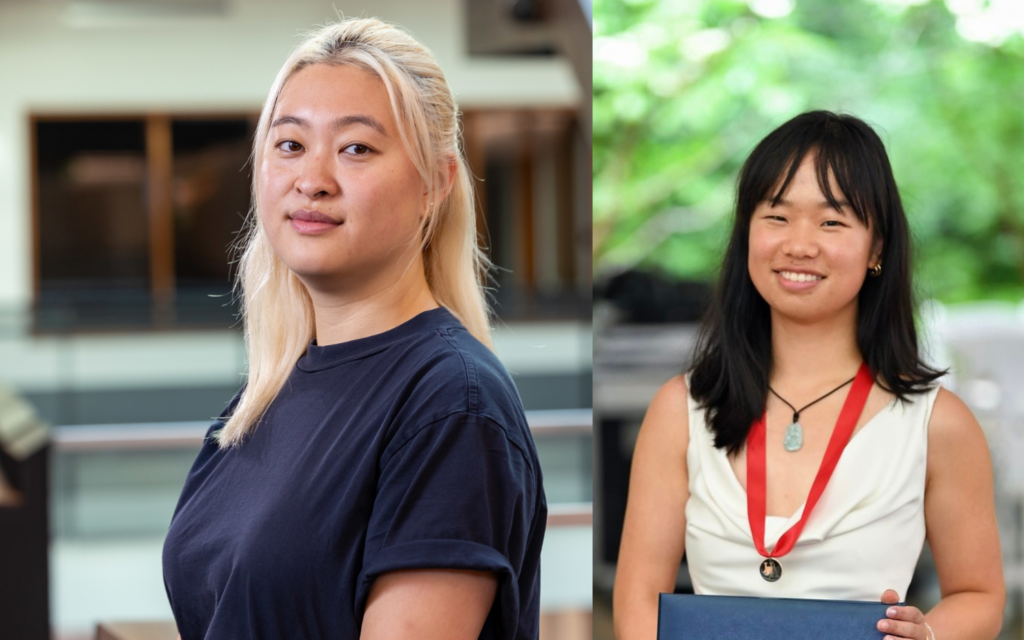
Miranda Wei studies online abuse and societal factors in sociotechnical safety, especially concerning social media, gender, and interpersonal relationships. Their research interests lie at the intersections of computer security and privacy (S&P), human-computer interaction (HCI), and feminist science and technology studies (STS). Wei recently sat down with Princeton undergraduate Grace Ding ’29 to discuss their research and what’s after their postdoc position at CITP.
Content warning: Wei’s interview involves text discussion about child sexual abuse material-related research. No graphic descriptions of such material is described.
Grace Ding: So just to start, can you tell us a little bit about yourself and your educational journey?
Miranda Wei: I’m an interdisciplinary researcher focusing on online safety. My background is in computer science and social science. Specifically, my undergrad was in political science, where I was working on international conflict and international security, which is very different from computer security and privacy.
During my bachelor’s, I was doing research on suicide terrorism and on militant propaganda. During the last quarter of my last year, I took an elective in computer science called Usable Security and Privacy, and that’s how I got involved in the research that I’m doing now! I really enjoyed that class, and I really saw the overlap between technology and how people were using technology, and also some of the broader social considerations that I thought were interesting from political science.
I did research at UChicago for 2 years with Professor Blase Ur. Blase encouraged me to apply for a PhD program in computer science, which at the time, I didn’t really know that much about, and I never really would have expected that to be the path that I took, but I was like – okay, sure – I’ll apply and see what happens.
I was very fortunate to get in, and I went to University of Washington, where I was at the Security and Privacy Lab, where I continued to do work at the intersection of human-computer interaction (HCI) and security and privacy. There, I really focused more on interpersonal harm – so that includes interpersonal surveillance: stalking, hate and harassment.
It could also include interpersonal control and interpersonal violence, and then later on working on some of the harms that come from image-based sexual abuse, [particularly] how that works, how people learn about it, how people seek help if they’re experiencing it, and also the role that AI plays in image-based sexual abuse.
“We need to think about it as a systemic problem that arises when people use technologies.”
Grace: That’s fascinating. I know that you recently gave a talk at the CITP on digital harm and image-based sexual abuse. Can you tell us a little bit more about what you discussed there?
Miranda: Yeah, so I framed the talk a bit more reflectively about some of the things that I’ve learned while working in this space of online safety and online harms. The two takeaways that I wanted to emphasize during that talk were: that harm is not an anomaly, and it’s also not a reason to despair.
So, by anomaly, I mean – oftentimes we think of harm as something that only happens to really, really vulnerable people, or [something] that only happens to you if you’re not careful, among a lot of other misconceptions about how harm really happens.
I don’t want to be alarmist here – and I’m not trying to say that you’re always at risk – but when we think of harm, we need to think about it as a systemic problem that arises when people use technologies.
You might be doing everything perfectly and still experience harm. When we think of harm as an anomaly, when we think of it as really unlikely, we don’t take care to take action and to think about what are the systemic things that we can do: safety by design, defense in depth – there are various approaches to consider from the very beginning.
So that’s also related to…it’s not a reason to despair.
“I don’t know that I’m gonna be able to solve it tomorrow, but the goal is to work towards a solution with other people who are also working on it.”
I often have heard people say things like, well, you know, bad people are bad, and so we can’t do anything about that. And I personally am really frustrated by that perspective. I mean, I understand it can be very daunting to take action, but, I think most researchers can agree that research is to do things that haven’t been done before, and that’s why I’m doing research – is to solve problems that we haven’t necessarily solved. I don’t know that I’m gonna be able to solve it tomorrow, but the goal is to work towards a solution with other people who are also working on it.
Grace: Can you tell us specifically about a project that you’re wrapping up now, or you’re still working on? I don’t know where you are with your research process, since I know that you’re moving to EPFL [Swiss Federal Technology Institute of Lausanne] this fall. Which, congratulations, by the way!
Miranda: Thank you! Yeah, I’m excited to join the amazing community there. One of the current projects that I’ve been working on is understanding the existing strategies we have for combating AI-enabled child sexual abuse material (AICSAM), and what kinds of limitations there are with being able to mitigate it or prevent it, and also, what other solutions might we need. The rise and the accessibility now of generative AI means that a lot of people have access to image generation models that they didn’t have before. But at the same time, child sexual abuse material isn’t new. That’s been a problem since even before any technology entered the picture.
We’ve been talking to policymakers and folks who work in government, as well as people in industry and people who work on child safety, in civil society or in NGOs. We’ve been doing these interviews as researchers where we can be third parties, and try to synthesize these viewpoints from people who normally wouldn’t have a conversation with each other.
There’s a lot of long-standing tensions, right? Regulators might be trying to hold industry people accountable, or industry people might have differing views than advocacy organizations, and so we’re hoping that by speaking to them, we can really try to synthesize some things out of that.
Grace: That makes a lot of sense. You mentioned that you were talking to policymakers. Considering your background in poli-sci, I think you come into this research with a really unique perspective, and I can see how it informs the questions that you’re asking and the avenues that you’re going down. I’m wondering if you feel like there are skills from that element of your education that have informed your work today?
Miranda: One thing I’ll say is that in the past, I was working on more international policy. I mean, I was also an undergrad doing research, and so I was learning about how to do research. Now some of the work is much more…domestic, I guess, for lack of a better term. I mean, these are tech policies about technologies and companies in the U.S., most often.
But broadly, I think there’s always a translation between research skills. I’ve mainly been a researcher, and so, one of the things that I find really valuable as an interdisciplinary researcher, is just being willing to read perspectives from a variety of different disciplines. Sometimes I am very grateful that as an undergrad in political science, it was not uncommon that in my classes we would have 3 books assigned as the reading for the week. For the week! Right? And that’s a lot of reading to do.
There was SparkNotes, but there wasn’t any AI-generated summary, so I had to actually read or skim most of that work, and that got me familiar with the idea of reading from a lot of different sources and trying to understand – how do computer scientists think about this? How do sociologists think about this? How do social workers think about this? These are different kinds of outputs, and it’s definitely served me to be able to read them.
Grace: Oh, I totally see that. Considering that you’re leaving us, unfortunately, this fall, how has your time here influenced the work that you’re planning to do at EPFL?
Miranda: I think one of the things that I’ve observed and really enjoyed about CITP is the experience that senior faculty and other people in the center have had with public policy and with engaging policymakers. I think a lot of people want their work to have that kind of impact, right? But knowing how to do that is a skill that takes a lot of time to learn, and I would say I’m still learning it. I think, to some extent, everyone is always still learning it, it’s always changing. It’s not quite like riding a bike, where once you know how to ride a bike, you can do everything. That’s one thing that I’ve really enjoyed, and I think that makes CITP unique.
Grace: Very cool, best of luck! And finally, is there anything that you wish you could have known as an undergrad, or life lessons that you’ve learned from your experiences in research that you’d want to share?
Miranda: One of the things that I’ve been thinking about is: how does the process of learning feel to me? I think in an ideal world, and in the most idealistic picture that I can paint of what it means to learn – is to be amazed. Just realizing that [there were] times when I thought I really had no idea what I was doing, I look back and I’m like – wow, I really grew so much that I didn’t even know at the time.
Another thing I’ve learned is that you don’t have to do everything right away. I wanted to do that. I have wanted to do that even now! I want to do the one research project that’s gonna incorporate all of my interests. And I just find that it’s never really possible. You have to do many individual projects that, at the end, you can maybe draw some lines and show how it’s all related. Your first research project doesn’t have to be the thing. No one’s gonna dig it up and ask “why aren’t you doing this anymore?” So just start with something, and then go from there.
Grace: I really appreciate that. Thank you for talking to me. This was amazing, and it was great to hear about your work, and once again, best of luck next year. You’ll be missed!
Grace Ding ’29 is a Student Associate for the Center of Information Technology working on the Meet the Researcher series. Originally from the DC metropolitan area, she is rising sophomore at Princeton University majoring in Computer Science. She’s broadly interested in science and technology studies, public interest technology, AI alignment, and tech ethics. When she’s not in class, she can be found at Baker Rink skating for Princeton’s Figure Skating Team.
Leave a Reply